Concrete Driveways in Lancaster, CA
A driveway is the biggest single piece of concrete most homes will ever have, and out here it takes the most punishment. New pours and full replacements across Lancaster and the Antelope Valley.
A driveway has a harder job than it looks. It carries the weight of every vehicle you own, it sits in full sun all day with nothing shading it, and it is the first thing anyone sees when they pull up to your house. When it goes, it goes visibly.
Most driveways in the Antelope Valley do not fail because the concrete was bad. They fail because the base underneath was never compacted properly, or because the control joints were cut too far apart, too shallow, or too late. Those are decisions made in the first day of the job, and they determine what the slab looks like in year ten.
We pour new driveways and we replace failed ones. If there is an old slab in the way, the tear-out and haul-away is part of the same job, so you are not coordinating two crews and two schedules.
What's included
What a driveway job actually covers
Demolition and haul away
If there is an existing slab, it comes out and it leaves the property. Broken concrete is not left stacked at the side of the house waiting on a second trip.
Grading and base prep
The subgrade gets cut to depth and compacted. This is the part nobody sees and the part that decides whether the slab is still flat in a decade.
Forms and reinforcement
Forms set to the finished grade and the drainage you actually want, with reinforcement sized to what the driveway will carry.
The pour and the finish
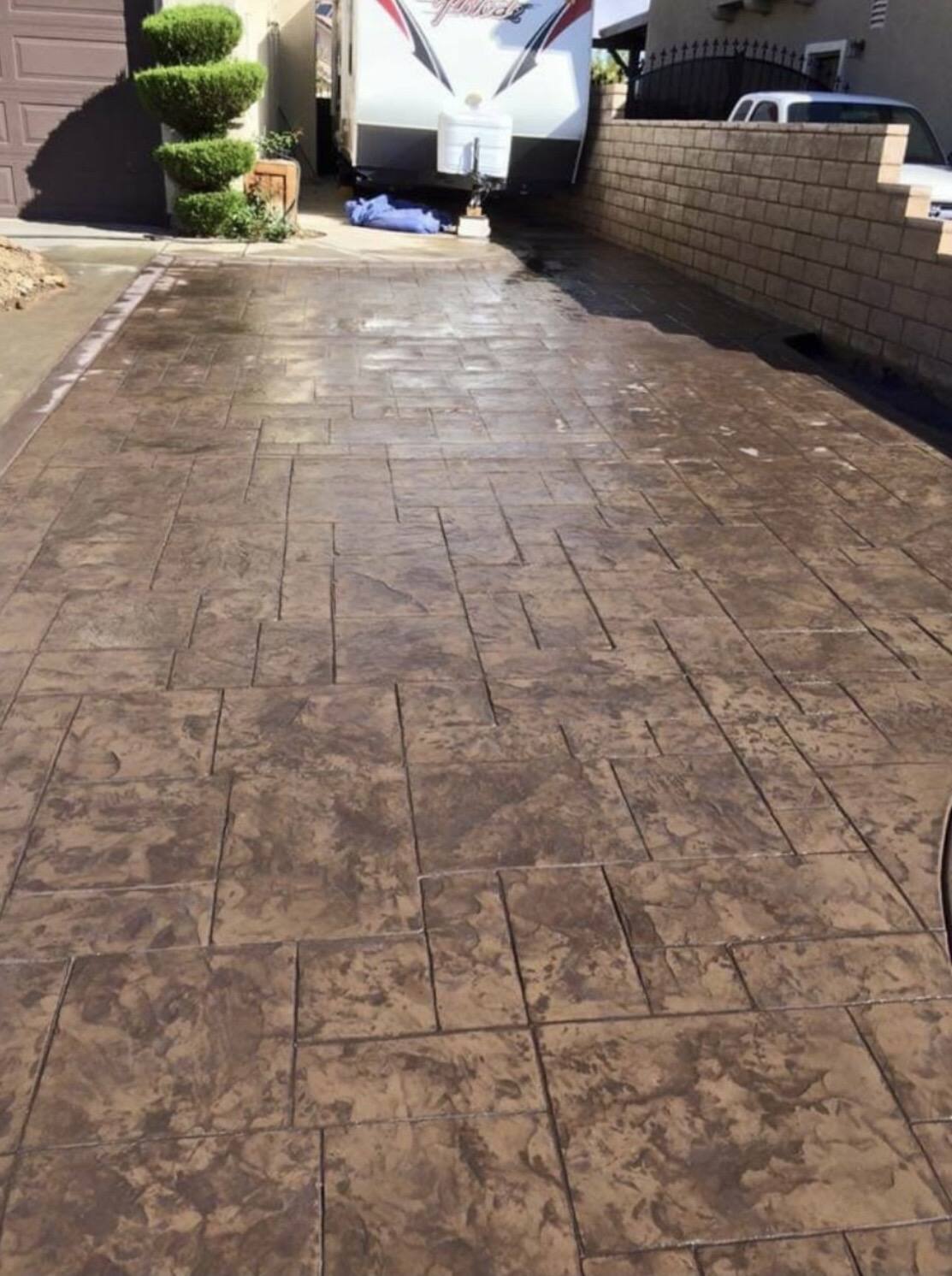
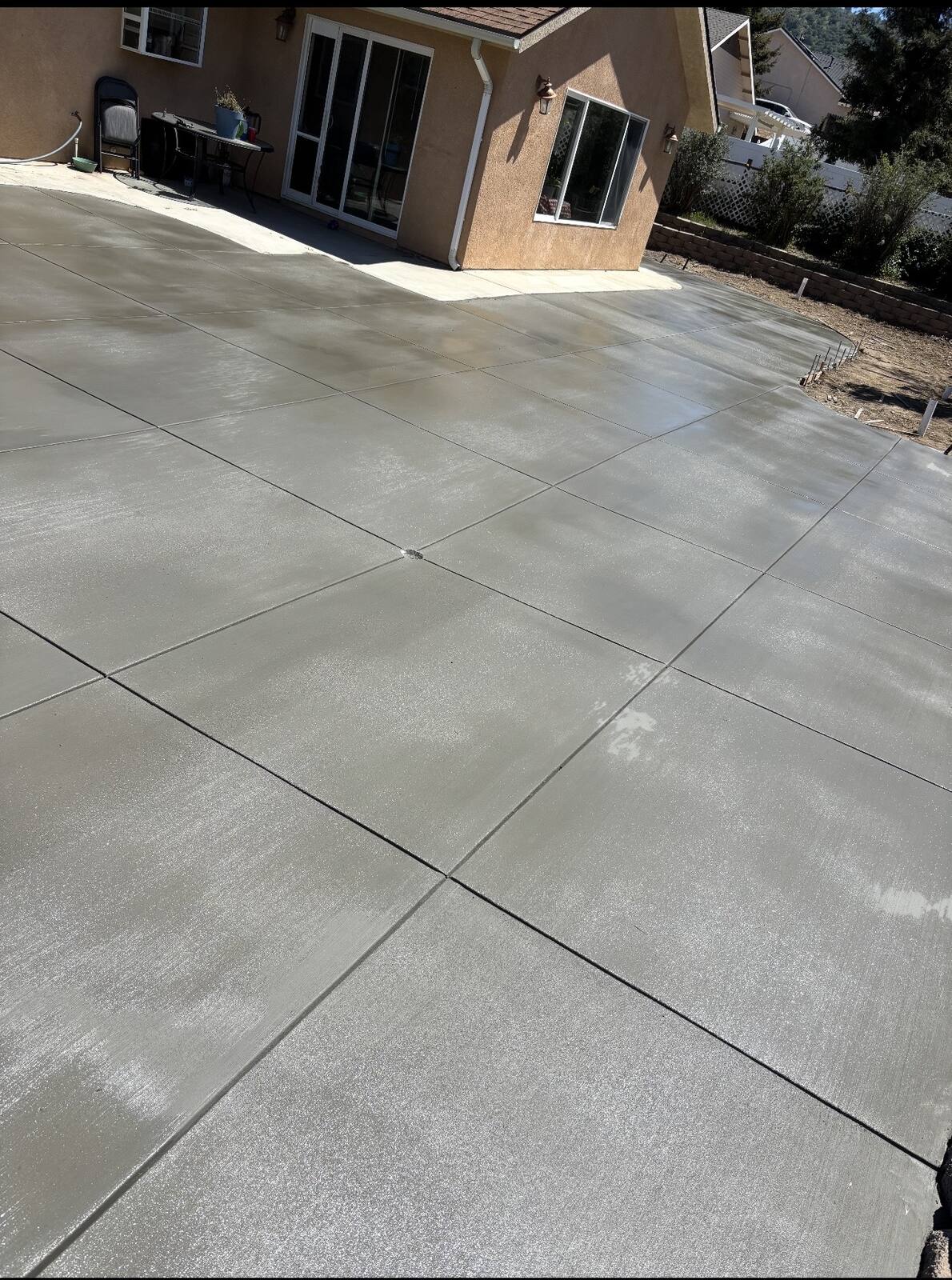
Broom finish as standard for traction, or a stamped and colored finish if you want the driveway to be a feature rather than a surface.
Control joints cut on time
Joints laid out to the slab thickness and cut inside the window where they still do their job. More on the timing below, because this is where most driveways are lost.
Cleanup and a straight handover
The site gets cleaned, and you get told plainly when you can walk on it, when you can drive on it, and when it will take something heavy.
Recent work
Driveways we have poured



How it goes
How a driveway job runs
Look at the site
We measure, check where water goes when it rains, and look at what the old slab is telling us about the base underneath it.
Scope and price it
A written number for the work as described, so you know what you are agreeing to before anything gets broken up.
Demo and prep
Old concrete out and gone, subgrade cut and compacted, forms set. Usually the longest part of the job and the part that matters most.
Pour, finish, joint
Placed and finished, then joints cut within the window. On a hot day that window is short, which is why the pour gets scheduled around the weather.
Cure and hand over
Curing started immediately instead of at the end of the day, and clear instructions on when it can take traffic.
Out here specifically
Why driveways crack here, and what we do about it
The Antelope Valley is a hot, dry, windy, high altitude place, and every one of those works against fresh concrete at the same time. July and August average daily highs near 98 degrees at Fox Field, humidity is low, the sun is close to unfiltered at this elevation, and the afternoon wind is nearly constant. NRMCA lists high air temperature, high concrete temperature, low humidity, wind and solar radiation as the five conditions that define hot weather concreting. Most summer days here have all five.
What that combination does is pull water off the surface faster than bleed water can rise to replace it. When that happens the surface shrinks while the concrete below it has not, and you get plastic shrinkage cracking before the slab has even set. The fixes are unglamorous and they work: dampen the subgrade without leaving standing water, put up a windbreak when the site needs one, and start curing immediately rather than treating it as an end of day task.
Then there is joint layout, which is where more driveways are lost than to anything else. NRMCA's guidance is joint spacing of 24 to 36 times the slab thickness, a groove cut at least a quarter of the slab depth and never less than an inch, and saw cuts made within four to twelve hours of finishing. On a standard four inch residential driveway that means joints eight to twelve feet apart, cut at least an inch deep, inside that four to twelve hour window. Concrete is going to move. Joints decide whether it moves where you planned or somewhere you did not.
One thing worth saying plainly, because a lot of national advice gets it wrong for this valley: expansive clay is not the problem here. Los Angeles County's own environmental report for the Antelope Valley states that none of the soils in the study area are classified as expansive under the Uniform Building Code table, with one exception out toward Rosamond Dry Lake. Our soils are sandy loams formed from granitic alluvium. When a slab fails around here it is usually base preparation, joints, or shrinkage, not clay heave. Deicing salt, which half the durability literature is written about, does not apply at all.
Questions we get
How long does a new concrete driveway take?
Most residential driveways are a few days of work spread across a week, depending on how much demolition there is and how the weather falls. The pour itself is one day. What takes the time is getting the old slab out and the base right underneath it.
When can I drive on it?
Plan on roughly seven days before car traffic and closer to thirty days before anything heavy, like an RV or a loaded truck. Concrete keeps gaining strength for weeks after it stops looking wet, and the first week is when it is easiest to damage permanently.
Can you just resurface my driveway instead of replacing it?
Sometimes. Resurfacing works when the slab underneath is structurally sound and the problem is surface wear or appearance. It does not work when the base has failed or the slab is moving, because the new surface will crack along exactly the same lines within a year.
Do I need a permit for a driveway?
It depends where you are. Lancaster and Palmdale are incorporated cities with their own building departments. Quartz Hill, Acton and Lake Los Angeles fall under Los Angeles County, and Rosamond is in Kern County. Work in the road right of way, like a driveway approach, is usually its own separate permit.
Why do you cut lines into a new driveway?
Those are control joints, and they are the whole strategy. Concrete shrinks as it cures and moves with temperature. Joints give it a planned place to crack, below the surface where you never see it, instead of letting it crack across the middle of the slab.
Can a driveway be stamped instead of plain?
Yes, and driveways are one of the better places for it because of the surface area. Stamped and colored concrete runs the same structure underneath with a pattern pressed into the surface. It costs more than a broom finish and it needs resealing on a cycle, which we will be straight with you about.
Where we do this
Concrete Driveways across the Antelope Valley
We pour driveways across the whole valley, on both sides of the county line.
Get an estimate
Tell us what you are looking at and we will get back to you with a real number, not a range.
Submission received
Thanks for the details. Manuel will call or text you back about it. If you would rather not wait, reach him directly at (661) 917-9145.